

Toutes les compétences
Perso
Liste de tâches vers plan de semaine
Une liste de tâches en vrac devient un plan de semaine serein, trois choses par jour.
La démo utilise des données fictives. La sortie affichée est ce que la compétence a produit avec cet exemple d'entrée.
Essaie en 3 étapes
- 01
Copie le dossier, ou seulement SKILL.md, dans .claude/skills/ de ton projet (ou dans ~/.claude/skills/ pour l'utiliser partout).
- 02
Ouvre Claude Code et demande-la par son nom, par exemple : Utilise la compétence weekly-planner sur mes fichiers.
- 03
Vérifie le résultat. Les compétences créent un nouveau fichier et n'écrasent jamais les tiens.
Voir un exemple d'exécution
Exemple d'entrée · input.md
# Week of Mon 19 Oct 2026

## Focus hours I have (after work and commitments)
- Mon: 3h
- Tue: 4h
- Wed: 2h
- Thu: 4h
- Fri: 3h
- Sat/Sun: none, family time

## Fixed commitments (do not plan over these)
- Mon 17:00 dentist
- Wed evening team dinner
- Thu 15:30 school pickup
- Sat: Ana's birthday party

## Tasks (hours are my own estimates)
- Draft Q4 budget deck, 3h, due Fri
- Reply to landlord about the leaking tap, 0.5h, urgent
- Book car service, 0.5h
- Write blog post draft, 2.5h
- Clean out the garage, 4h
- Renew gym membership, 0.5h
- Buy and wrap gift for Ana, 1h, needed before Sat
- Learn pivot tables, 2h
- Plan Mum's visit next week, 1h
- Organise holiday photos, 3h
Exemple de sortie · output.md
# Weekly plan: week of Mon 19 Oct 2026
Planned 11h of 16h available. Buffer 5h.
All tasks total 18h, so 7h moves to next week.

## Hours check
| Day | Available | Capacity (80%) | Planned | Buffer |
|---|---|---|---|---|
| Mon | 3h | 2h | 2h | 1h |
| Tue | 4h | 3h | 3h | 1h |
| Wed | 2h | 1.5h | 1h | 1h |
| Thu | 4h | 3h | 3h | 1h |
| Fri | 3h | 2h | 2h | 1h |
| Total | 16h | 11.5h | 11h | 5h |

## Day by day
### Mon (2h, 3 tasks)
- [ ] Reply to landlord about the leaking tap (0.5h)
- [ ] Book car service (0.5h)
- [ ] Plan Mum's visit next week (1h)

### Tue (3h, 1 task)
- [ ] Draft Q4 budget deck (due Fri) (3h)

### Wed (1h, 1 task)
- [ ] Buy and wrap gift for Ana (before Sat) (1h)

### Thu (3h, 2 tasks)
- [ ] Write blog post draft (2.5h)
- [ ] Renew gym membership (0.5h)

### Fri (2h, 1 task)
- [ ] Learn pivot tables (2h)

## Not this week
- Clean out the garage (4h): big block, no deadline
- Organise holiday photos (3h): no deadline, would use the buffer

## Notes
- Fixed items kept clear: Mon 17:00 dentist, Wed dinner, Thu 15:30 pickup, Sat party.
- Assumption: the focus hours you gave already exclude those commitments.
- Saturday and Sunday are left empty on purpose.
La compétence · SKILL.md
---
name: weekly-planner
description: Turns a messy task list, the hours available each day and fixed commitments into a calm weekly plan with at most three tasks a day, a buffer, and a "not this week" list. Use when someone pastes to-dos and asks what is realistic for the week.
---
# Weekly Planner
A messy list becomes a plan you can actually finish, with the hours added up for you.

## When to use
- The user pastes a task list and wants a realistic week.
- The user feels overloaded and needs to decide what to drop.

## Inputs
- Tasks with an hour estimate each (ask for missing estimates; do not guess them).
- Focus hours available per day. Ask if missing.
- Fixed commitments, deadlines and anything urgent.
- Optional: the user's buffer preference. Default is 20% of each day.

## Steps
1. Read the input file and list every task with hours, deadline and urgency.
2. Compute each day's planning capacity: available hours x 0.8, rounded down to the nearest 0.5h. The rest is the buffer.
3. Sort tasks: urgent first, then those with a deadline, then by importance the user stated.
4. Place tasks on days, earliest feasible day for deadlines. Maximum three tasks per day. Never split a task unless the user allows it.
5. Check the totals with code or a calculator: planned hours per day must be <= capacity, and total planned <= total available.
6. Move everything that does not fit to "Not this week" and say why in a few words.
7. Re-run the check, then write the file.

## Output
Write a new file `weekly-plan.md` next to the input (if it exists, use `weekly-plan-2.md`). Never overwrite the input. Template:
```
# Weekly plan: <week>
Planned <X>h of <Y>h available. Buffer <Z>h.
## Hours check
| Day | Available | Planned | Buffer |
## Day by day
### Mon (<planned>h, <n> tasks)
- [ ] Task (<hours>h)
## Not this week
- Task (<hours>h): reason
## Notes
```

## Rules
- Never invent tasks, estimates, deadlines or availability. Ask when something is missing.
- Never schedule more hours than the user has available, and never plan more than three tasks in a day.
- Never plan over a fixed commitment.
- Show the arithmetic so the user can check it.
- Mark any assumption clearly as an assumption.
- Write results to a new file, never overwrite the user's files.
- Keep the user's data local; do not send it anywhere.
- Out of scope: medical, legal or financial advice.
Les compétences t'aident à lire et à organiser. Ce ne sont pas des conseils juridiques, médicaux, fiscaux ou financiers.
Plus de compétences
 E-mails vers priorités et brouillonsDes e-mails collés deviennent une liste de priorités avec des brouillons de réponse.
 Notes de cours vers fiches et quizDes notes de cours deviennent des fiches de révision et un court quiz.
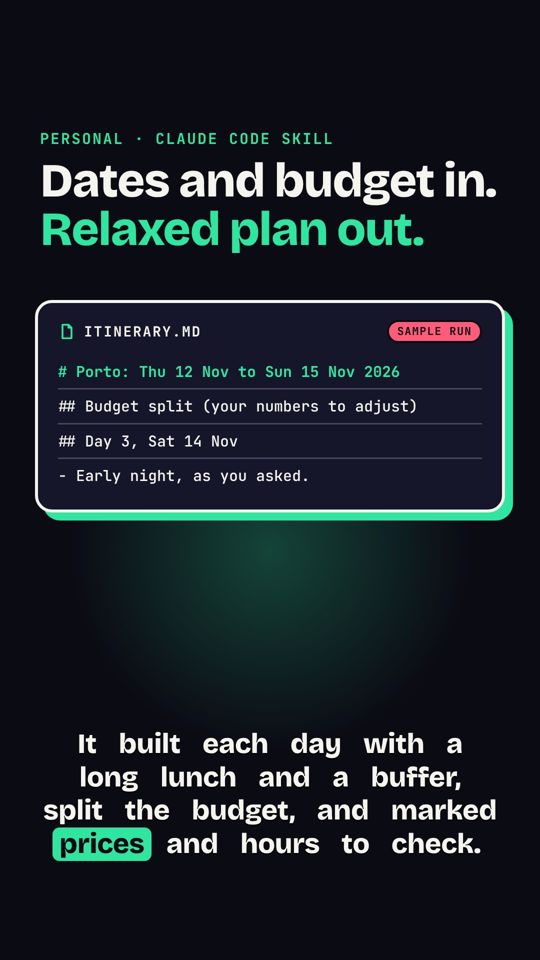 Contraintes de voyage vers programmeDes contraintes de voyage deviennent un programme jour par jour, avec marges et budget.