

Alle Skills
Persönliches
Lernnotizen zu Karteikarten und Quiz
Lernnotizen werden zu Karteikarten und einem kurzen Quiz.
Die Demo nutzt erfundene Daten. Die gezeigte Ausgabe ist das, was der Skill aus dieser Beispieleingabe erzeugt hat.
In 3 Schritten ausprobieren
- 01
Kopiere den Ordner oder nur SKILL.md nach .claude/skills/ in deinem Projekt (oder nach ~/.claude/skills/, um ihn überall zu nutzen).
- 02
Öffne Claude Code und frag ihn mit Namen an, zum Beispiel: Nutze den Skill study-coach für meine Dateien.
- 03
Prüfe das Ergebnis. Skills schreiben eine neue Datei und überschreiben nie deine eigenen.
Beispieldurchlauf ansehen
Beispieleingabe · input.txt
Water cycle notes - Year 7 Geography
The water cycle is the continuous movement of water between the sea, the air and the land.
The Sun's heat powers the whole cycle.
Evaporation: heat turns liquid water into water vapour, a gas. Most evaporation happens over the oceans.
Transpiration: plants release water vapour from their leaves.
Condensation: as vapour rises it cools and turns back into tiny liquid droplets, which form clouds.
Precipitation: when droplets in clouds grow heavy they fall as rain, snow, sleet or hail.
Collection: water gathers in oceans, lakes, rivers and underground.
Runoff: water that flows over the land surface into rivers and streams.
Infiltration: water soaking down into the soil.
Groundwater: water stored in soil and rock underground. The top of it is called the water table.
An aquifer is a layer of rock that holds groundwater.
About 97% of Earth's water is salt water in the oceans.
Only about 3% is fresh water, and most of that is frozen in ice caps and glaciers.
Sublimation: ice turning straight into vapour without becoming liquid first.
Class experiment: we covered a bowl of warm water with cling film and put ice on top.
Droplets formed on the underside of the film. This showed condensation.
Mr Okafor said a cloud is made of tiny droplets, not of vapour.
Key terms to learn: evaporation, condensation, precipitation, collection.
The water cycle has no start or end point.
Rivers flow downhill towards the sea because of gravity.
Deserts get little precipitation, less than 250 mm per year.
Rainforests get lots of precipitation and have high transpiration.
Homework: draw and label the cycle with arrows.
Test on Friday.
Beispielausgabe · output.md
# Study pack: The water cycle (Year 7 Geography)

## Flashcards (12)
1. **Front:** What powers the water cycle? | **Back:** The Sun's heat. (line 3)
2. **Front:** Evaporation | **Back:** Heat turns liquid water into water vapour, a gas. (line 4)
3. **Front:** Transpiration | **Back:** Plants release water vapour from their leaves. (line 5)
4. **Front:** Condensation | **Back:** Rising vapour cools and turns into tiny liquid droplets that form clouds. (line 6)
5. **Front:** Precipitation | **Back:** Heavy droplets fall as rain, snow, sleet or hail. (line 7)
6. **Front:** Collection | **Back:** Water gathers in oceans, lakes, rivers and underground. (line 8)
7. **Front:** Runoff | **Back:** Water that flows over the land surface into rivers and streams. (line 9)
8. **Front:** Infiltration | **Back:** Water soaking down into the soil. (line 10)
9. **Front:** Water table | **Back:** The top of the groundwater stored in soil and rock. (line 11)
10. **Front:** Aquifer | **Back:** A layer of rock that holds groundwater. (line 12)
11. **Front:** How much of Earth's water is fresh? | **Back:** About 3%, mostly frozen in ice caps and glaciers. (line 14)
12. **Front:** Sublimation | **Back:** Ice turning straight into vapour without becoming liquid first. (line 15)

## Quiz (6 questions)
1. What happens to water vapour as it rises?
2. What is a cloud made of, according to Mr Okafor?
3. Why do rivers flow downhill towards the sea?
4. In the class experiment, what did the droplets under the cling film show?
5. What percentage of Earth's water is salt water in the oceans?
6. How much precipitation do deserts get per year?

## Answers
1. It cools and turns back into tiny liquid droplets, forming clouds. (line 6)
2. Tiny droplets, not vapour. (line 18)
3. Because of gravity. (line 21)
4. Condensation. (lines 16-17)
5. About 97%. (line 13)
6. Less than 250 mm per year. (line 22)

## Gaps to ask your teacher
- Line 20 says the cycle has no start or end point; the notes do not explain why.
- The notes list "collection" as a key term but give no examples beyond line 8.
Der Skill · SKILL.md
---
name: study-coach
description: Turns a student's own study notes into 12 flashcards and a 6-question quiz with answers, all answerable from the notes alone. Use when someone pastes or attaches class notes and wants to revise for a test. Marks gaps in the notes instead of filling them from outside knowledge.
---
# Study Coach
Your notes in, 12 flashcards and a 6-question quiz out, every answer traceable to a line.

## When to use
- A student has notes on one topic and wants revision material.
- A parent or tutor wants practice questions based on what the class actually covered.

## Inputs
- The notes as a text or Markdown file. Ask for them if only a topic name is given.
- Optional: test date, level, and terms the student finds hard.

## Steps
1. Read the notes and number each line (keep a private map of line numbers).
2. List the facts that are stated clearly: definitions, numbers, examples, cause and effect.
3. Pick 12 distinct facts for flashcards. Spread them across the notes and cover every "key terms" line the notes list.
4. Write each card as a short question or term on the front and a one-sentence answer on the back, using the notes' wording.
5. Pick 6 different facts for the quiz. Mix types: two recall, two "why/how", one number, one experiment or example if the notes contain one.
6. Write each question so one short answer is correct. Add the answer and the source line number.
7. Check every card and question: if the answer is not in the notes, replace it. Count 12 cards and 6 questions.
8. List topics the notes mention but do not explain, as "Gaps to ask your teacher".

## Output
Write a new file `study-pack.md` next to the notes (if it exists, use `study-pack-2.md`). Never overwrite the notes. Template:
```
# Study pack: <topic>
## Flashcards (12)
**1. Front:** ... | **Back:** ... (line N)
## Quiz (6 questions)
1. Question
## Answers
1. Answer (line N)
## Gaps to ask your teacher
```

## Rules
- Never invent facts, numbers or definitions; use only what the notes say.
- Do not add outside knowledge, even if the notes look wrong; flag the line as "check with your teacher".
- Every answer cites its note line number.
- Do not repeat the same fact across cards and quiz questions.
- Write results to a new file, never overwrite the user's files.
- Keep the notes local; do not send them anywhere.
- Out of scope: grading, medical, legal or financial advice.
Skills helfen dir beim Lesen und Ordnen. Sie ersetzen keine Rechts-, Medizin-, Steuer- oder Finanzberatung.
Weitere Skills
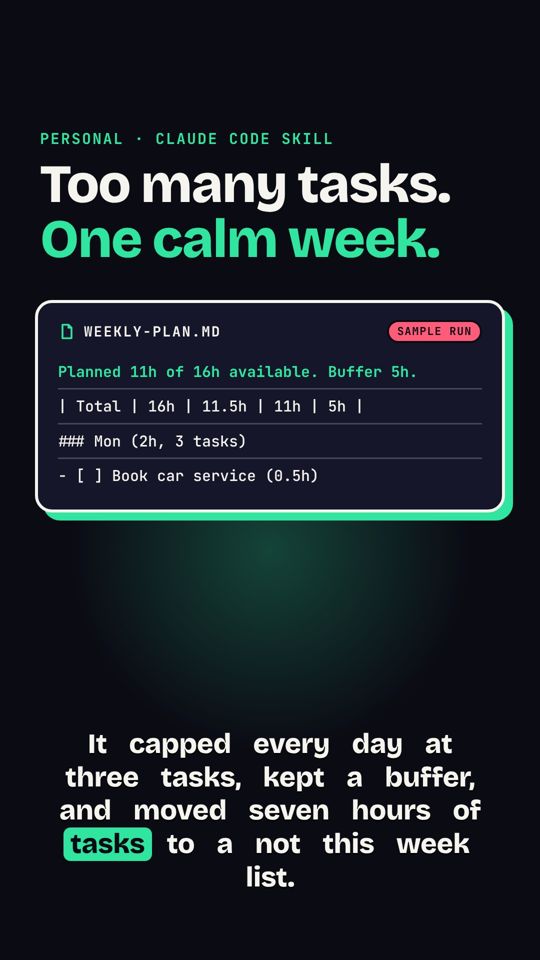 Chaos-Aufgabenliste zu WochenplanEine chaotische Aufgabenliste wird zu einem ruhigen Wochenplan, drei Dinge pro Tag.
 E-Mails zu Prioritäten und EntwürfenEingefügte E-Mails werden zu einer Prioritätenliste mit Antwortentwürfen.
 Reisewünsche zu TagesplanReisewünsche werden zu einem Tagesplan mit Puffern und Budget.